The Exploration Capability

S³ Paper 010
The Exploration Capability
Why Strategic Research and Applied Research Belong Together
Introduction
Every organisation is designed around capabilities that it considers essential to its long-term success. Finance exists because organisations recognise that capital cannot be managed effectively through ad hoc decision-making. Operations exists because reliable delivery requires dedicated expertise rather than individual effort alone. Product organisations have emerged because creating and evolving successful products demands a disciplined approach to understanding customer needs, coordinating development and balancing long-term investment with short-term priorities. Human Resources, Legal, Marketing and countless other functions have followed a similar path. Although their responsibilities differ, they share a common characteristic: each represents work that organisations have concluded is sufficiently important to deserve its own leadership, governance, investment and professional discipline.
These capabilities did not appear fully formed. They evolved as organisations became more complex and recognised that certain responsibilities could no longer remain fragmented across existing departments. Over time, they became institutionalised. They acquired recognised methodologies, professional standards, career pathways and executive sponsorship because organisations understood that their contribution extended beyond individual projects. They represented capabilities that needed to endure regardless of changes in personnel, organisational structure or market conditions.
The evolution of execution provides perhaps the clearest example of this process. Modern organisations have become exceptionally good at designing, building, delivering and continuously improving products and services. Product Management has matured into a recognised profession. Operations has become a strategic capability responsible for reliability, scalability and continuous improvement. Artificial intelligence, low-code platforms and increasingly sophisticated development tools have accelerated this progress even further, enabling organisations to prototype, iterate and deliver solutions at a pace that would have seemed extraordinary only a few years ago. Few would dispute that this represents genuine progress.
Execution, however, begins only after one of the most important organisational decisions has already been made. Before a roadmap is created, before investment is approved and before delivery begins, an organisation must first determine that a meaningful opportunity exists and that it deserves commitment. This moment rarely receives the same organisational attention as execution because it sits beyond the boundaries of delivery. It belongs to an earlier stage of organisational thinking, where uncertainty outweighs evidence and the organisation has yet to determine whether any response should exist at all.
It is this stage that I believe has been largely overlooked in modern organisational design. Organisations have become highly intentional about institutionalising execution, yet comparatively little attention has been given to institutionalising exploration. Exploration undoubtedly occurs. Every organisation studies markets, monitors emerging technologies, investigates changing customer needs, evaluates societal and regulatory change and experiments with new ideas. The difference is that these activities rarely exist as a coherent organisational capability. Instead, they are distributed across multiple functions, each contributing valuable work but none assuming responsibility for exploration as a complete organisational discipline.
This paper argues that the missing capability is not innovation, nor strategy, nor research viewed in isolation. It is the deliberate combination of Strategic Research and Applied Research into a single organisational capability responsible for discovering future opportunities and generating the evidence required before significant organisational commitment occurs. Just as Product and Operations together provide organisations with a coherent capability for execution, Strategic Research and Applied Research together provide a coherent capability for exploration. Recognising this distinction is not simply a question of organisational structure. It changes how organisations discover, evaluate and ultimately create their future.
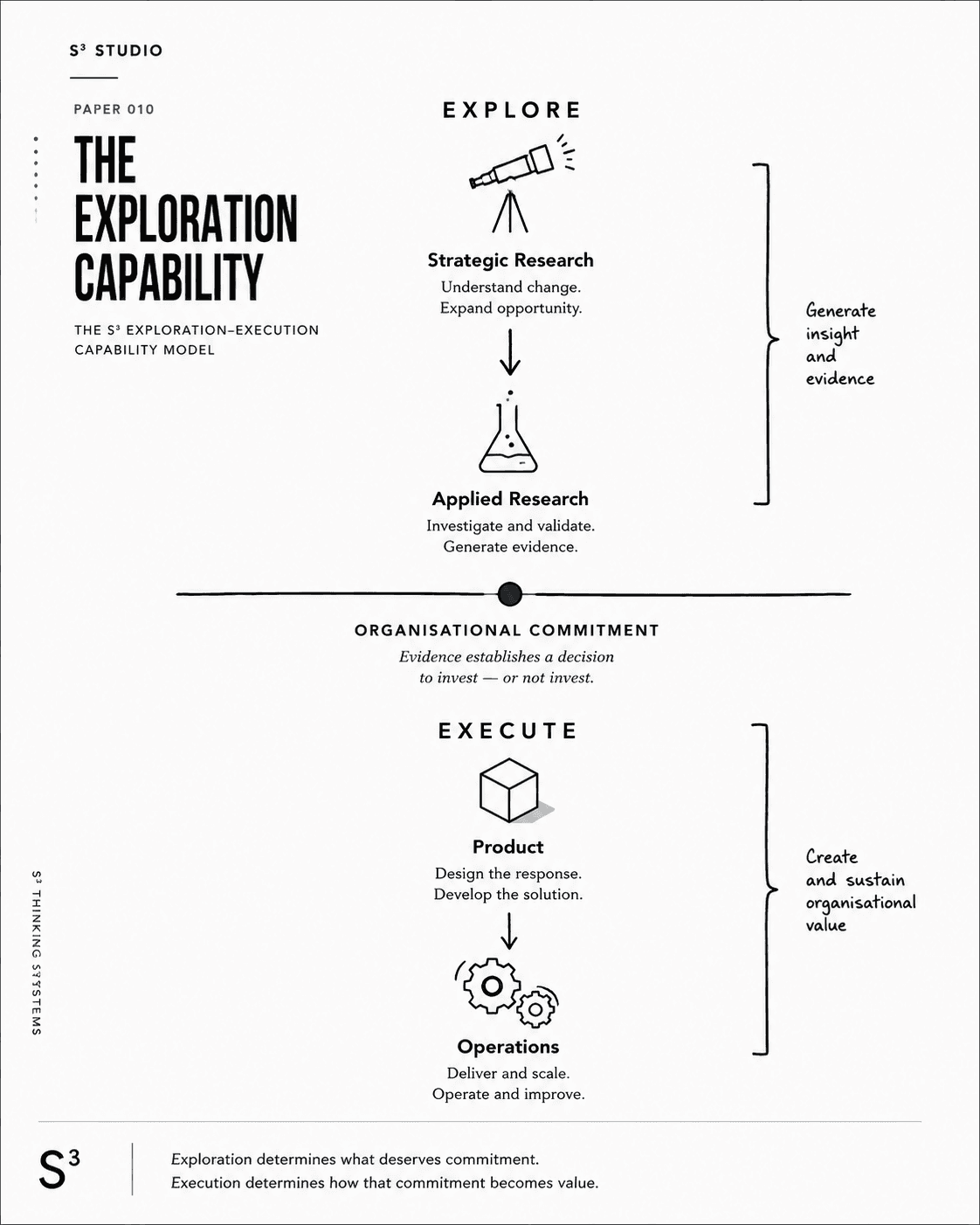
Figure 1 illustrates the relationship between the two organisational capabilities proposed in this paper. Exploration and execution should not be viewed as competing organisational responsibilities, but as complementary capabilities separated by a deliberate point of organisational commitment. Exploration discovers opportunities and generates evidence. Execution transforms that evidence into products, services and other forms of sustained organisational value.
Strategic Research and Applied Research
Recognising exploration as an organisational capability naturally raises a second question. If exploration is not simply a collection of activities undertaken by different parts of the organisation, what disciplines actually comprise it?
The answer lies in two complementary forms of research that perform consecutive stages of the same organisational responsibility. Although they are frequently separated within organisational structures, their purpose is fundamentally shared: to move an organisation from uncertainty to informed commitment.
The first is Strategic Research. Its responsibility is not to identify the next feature, improve an existing service or validate a predefined solution. Instead, it seeks to understand how the environment in which the organisation operates is changing and what those changes may mean for its future. Emerging technologies, demographic shifts, evolving customer expectations, environmental pressures, geopolitical developments, regulatory change and new business models become subjects of investigation because they reveal patterns that may fundamentally reshape how value is created. Strategic Research therefore expands the organisation's field of vision. It challenges prevailing assumptions, identifies opportunities before they become obvious and enables leaders to consider futures that extend beyond the boundaries of today's products, services and operating models.
Recognising an opportunity, however, is only the beginning. Every opportunity initially exists as a possibility rather than a certainty, and possibilities alone rarely justify meaningful organisational investment. Between recognising an opportunity and committing resources lies a period during which uncertainty must be progressively reduced through disciplined enquiry rather than optimistic assumption. This is the responsibility of Applied Research.
Applied Research inherits the opportunities identified through Strategic Research and subjects them to increasingly rigorous investigation. Assumptions become hypotheses, hypotheses become experiments, and experiments generate evidence through prototypes, pilots, beta programmes, minimum viable offerings and other forms of real-world validation. Its purpose is not to produce a finished solution, but to establish whether the opportunity itself deserves organisational commitment. Success is therefore measured not by the number of products, services or platforms it creates, but by the quality of the evidence it generates.
This distinction is fundamental because, at this stage, the organisation has not yet determined what form its response should take. A validated opportunity may ultimately result in a product, but it may equally lead to a professional service, a digital platform, an operational capability, a strategic partnership, a policy, a new business model or another form of intervention entirely. In some circumstances, the most valuable outcome of Applied Research is the evidence that no intervention should occur at all. Exploration remains deliberately solution-agnostic because its responsibility is not to determine how an organisation should respond, but to ensure that any response is grounded in evidence rather than assumption.
Viewed independently, Strategic Research and Applied Research appear to perform different kinds of work. One broadens the organisation's understanding of what could exist, while the other establishes whether those possibilities deserve investment. One expands the opportunity space; the other progressively narrows it through evidence. Together, however, they fulfil a single organisational responsibility. Strategic Research identifies opportunities worthy of investigation. Applied Research determines whether those opportunities merit organisational commitment. Together they transform uncertainty into organisational confidence.
Institutionalising Exploration
The significance of this distinction extends beyond terminology. Organisations rarely create dedicated capabilities unless they recognise that the underlying responsibility is fundamental to long-term performance. Product and Operations became institutionalised because organisations concluded that execution could not remain fragmented across individual projects or isolated teams. Delivering value consistently required a coherent capability with clear leadership, governance and accountability.
Exploration deserves the same recognition.
Strategic Research and Applied Research are often treated as isolated activities undertaken before "the real work" begins, or as responsibilities that naturally belong to whichever function happens to require them at the time. This perspective misunderstands their purpose. Exploration is not a temporary phase that precedes execution; it is a continuous organisational capability responsible for ensuring that future investment is directed towards opportunities that genuinely deserve commitment.
Understanding exploration in this way also changes how organisations think about the relationship between research and execution. Exploration does not compete with Product, nor does it replace the responsibilities of Operations. Rather, it precedes them. Once sufficient evidence exists, responsibility naturally passes to the capabilities responsible for execution, where the organisation determines how the validated opportunity should be realised, delivered, scaled and continuously improved. The relationship is sequential rather than competitive, with each capability performing a distinct but complementary role within a broader process of organisational value creation.
Perhaps this explains why many organisations become increasingly effective at improving what they already do while finding it more difficult to identify opportunities that lie beyond their existing portfolio. Execution has become a mature organisational capability because it has been deliberately designed, invested in and continuously refined. Exploration, by contrast, often remains fragmented across multiple functions, making it dependent upon individual initiative rather than institutional capability.
Conclusion
Every organisation explores. The question is not whether exploration occurs, but whether it has been recognised as a capability deserving the same organisational attention as execution.
Strategic Research and Applied Research should not be viewed as separate disciplines connected only by circumstance. Together they form a continuous organisational capability responsible for understanding change, discovering opportunities and generating the evidence required before significant organisational commitment occurs. Their purpose is not to build products, deliver services or develop platforms, but to enable organisations to determine which opportunities are worth pursuing and which are not.
For more than half a century, organisations have refined the capabilities responsible for execution. Product, Operations and other delivery functions have become increasingly sophisticated because organisations understand that consistent execution requires deliberate investment. The next stage of organisational maturity may not lie in building faster, but in becoming more deliberate about discovering what is worth building in the first place.
Recognising Strategic Research and Applied Research as a coherent Exploration Capability does more than reshape an organisational chart. It establishes a dedicated capability responsible for transforming uncertainty into evidence before significant commitment occurs, allowing execution to begin with greater confidence and clearer purpose. Organisations that invest deliberately in both exploration and execution will be better equipped not only to respond to change, but to shape it.